UNESCO Rejects Philippines’ Bid to List Chocolate Hills After Discovering They Are Not, In Fact, Chocolate
CARMEN, Bohol — The United Nations Educational, Scientific and Cultural Organization (UNESCO) has formally rejected the Philippines’ application to designate the Chocolate Hills of Bohol as a World Heritage Site, citing what it described as a “fundamental misunderstanding of both geology and dessert.”
In a 43-page assessment released Monday, UNESCO confirmed that despite the site’s name, chocolate-colored appearance during the dry season, and the “confidently suggestive language” in the Philippine submission, the 1,268 conical hills are not made of chocolate, have never been made of chocolate, and showed no realistic potential to become chocolate in the future.
Photo: The Chocolate Hills of Bohol, where no chocolate has been found.
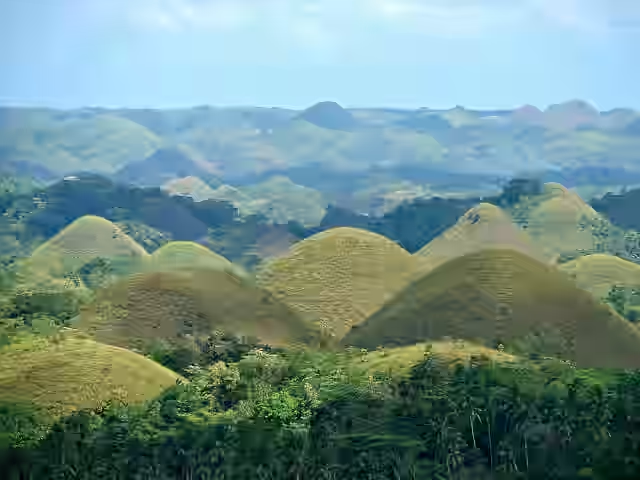
“Our mandate requires a minimum standard of material accuracy,” said Dr. Étienne Lavoisier, head of UNESCO’s Cultural Landscapes Evaluation Committee. “In this case, the hills are limestone formations. Limestone is not chocolate. This was not a close call.”
No Cacao Trees, No Cocoa
According to the report, UNESCO’s investigative team spent three weeks surveying the site for any evidence that might support the Philippine application’s repeated references to “naturally occurring chocolatey landforms.”
“Not a single cacao tree was found,” the report states. “Nor were there cocoa pods, cocoa beans, or any agricultural infrastructure suggesting an indigenous, chocolate-consuming civilization.”
Investigators also noted that local vegetation consisted primarily of grass, shrubs, and trees “that have never once been made into confectionery.”
One field note reads simply: ‘Tasted leaf. Not chocolate.’
Soil Sample Fails Critical Beverage Test
In an effort to give the submission “every possible benefit of the doubt,” UNESCO scientists collected soil samples from multiple hills and attempted to prepare traditional hot chocolate drink at their temporary field office in Sagbayan, Bohol.
The process involved grinding the soil, heating it with water, and adding sugar “to account for possible bitterness caused by terroir.”
“The resulting beverage was chocolate-brown, yes,” said Lavoisier. “But so is sewage runoff. Color alone is not evidence.”
Testers described the drink as having “strong notes of damp earth,” “a tinge of bitter disappointment,” and “the unmistakable aftertaste of mud.”
“No marshmallow could save it,” the report adds.
Submission Language Raised Red Flags
UNESCO officials also expressed concern over the tone of the Philippine application, which repeatedly used phrases such as ‘chocolate-like,’ ‘resembling chocolate,’ and ‘chocolate-based geomorphology,’ while never explicitly stating that the hills were edible.
Another passage described the hills as “melting visually under intense sunlight,” which UNESCO clarified was “grass drying out.”
In a brief statement, the Philippine Department of Tourism acknowledged UNESCO’s findings and said the application may have “leaned too heavily into poetic branding.”
“We regret any confusion,” the statement read. “The Chocolate Hills are actually just chocolate in spirit.”
UNESCO, however, confirmed that spirit-based chocolate does not meet World Heritage criteria.
Hills Remain Unchanged, Non-Chocolate
Despite the rejection, the Chocolate Hills will remain a major tourist attraction, continuing their centuries-long existence as non-chocolate, conical mounds of dirt.
When asked whether UNESCO would reconsider the application in the future, Lavoisier was cautious. “If, at some point, the hills demonstrably become chocolate,” he said, “we are open to reevaluating the case.”
Until then, UNESCO encourages visitors to “enjoy the landscape responsibly” and to obtain their chocolate from “reputable, dessert-specific sources.”